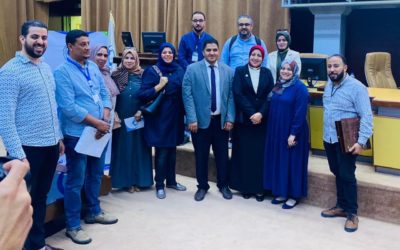
The First Awareness Activity on Quality Assurance and Performance Evaluation Management at Benghazi University for the Year 2020 on March 2-3, 2020
Opening Statement:
In the name of Allah, the Most Gracious, the Most Merciful, may peace and blessings be upon our Prophet Muhammad and his family and companions.
I extend a warm welcome on behalf of the Quality Team at the Quality Assurance and Performance Evaluation Office at the university. I highly appreciate your attendance, which reflects your commitment to supporting the quality initiatives at the university and your understanding of their significance and necessity for implementation.
As we are all aware, higher education institutions face challenges and difficulties in the era of globalization, the information revolution, and global shifts, which have significant impacts on the job market. Thus, they are compelled to lead societal change towards desired aspirations and hopes. This necessitates a shift in their current administrative methodologies and the adoption of new managerial concepts that empower them to establish effective new systems to enhance performance, increase efficiency, and improve the quality of their outputs, thereby achieving competitive capabilities commensurate with these challenges.
Consequently, many educational institutions have sought contemporary managerial methods to overcome their problems and adapt to the changes and demands of the era, moving away from the traditional management paradigm to modern managerial approaches. The application of modern managerial methods is deemed a cornerstone for the reform of administrative processes within the Libyan higher education system and its development, as it is responsible for regulating and leading academic work, and for fostering a scientific environment conducive to better university performance. These approaches yield organizational, regulatory, and competitive benefits to the university upon their application.
These approaches are built on a set of standards aimed at enhancing performance within the available resources, utilizing various means to assess and monitor any improvements and developments in the quality of services or products. Hence, the idea for this lecture arose to introduce some of these managerial approaches, through which administrative processes in our esteemed university can be developed, and to elucidate the most important principles and how to employ them in the development of the administrative system in higher education in accordance with international standards, thereby supporting the roles of administrators, managers, and academics in achieving their goals with efficiency and effectiveness.
May Allah grant us success.